

Quarterly earnings results are a good time to check in on a company’s progress, especially compared to its peers in the same sector. Today we are looking at Universal Display (NASDAQ:OLED) and the best and worst performers in the analog semiconductors industry.
Demand for analog chips is generally linked to the overall level of economic growth, as analog chips serve as the building blocks of most electronic goods and equipment. Unlike digital chip designers, analog chip makers tend to produce the majority of their own chips, as analog chip production does not require expensive leading edge nodes. Less dependent on major secular growth drivers, analog product cycles are much longer, often 5-7 years.
The 14 analog semiconductors stocks we track reported a very strong Q2. As a group, revenues beat analysts’ consensus estimates by 1.8% while next quarter’s revenue guidance was 4.9% above.
While some analog semiconductors stocks have fared somewhat better than others, they have collectively declined. On average, share prices are down 3.7% since the latest earnings results.
Universal Display (NASDAQ:OLED)
Serving major consumer electronics manufacturers, Universal Display (NASDAQ:OLED) is a provider of organic light emitting diode (OLED) technologies used in display and lighting applications.
Universal Display reported revenues of $152.2 million, down 11.4% year on year. This print fell short of analysts’ expectations by 3.6%. Overall, it was a mixed quarter for the company with a beat of analysts’ EPS estimates.
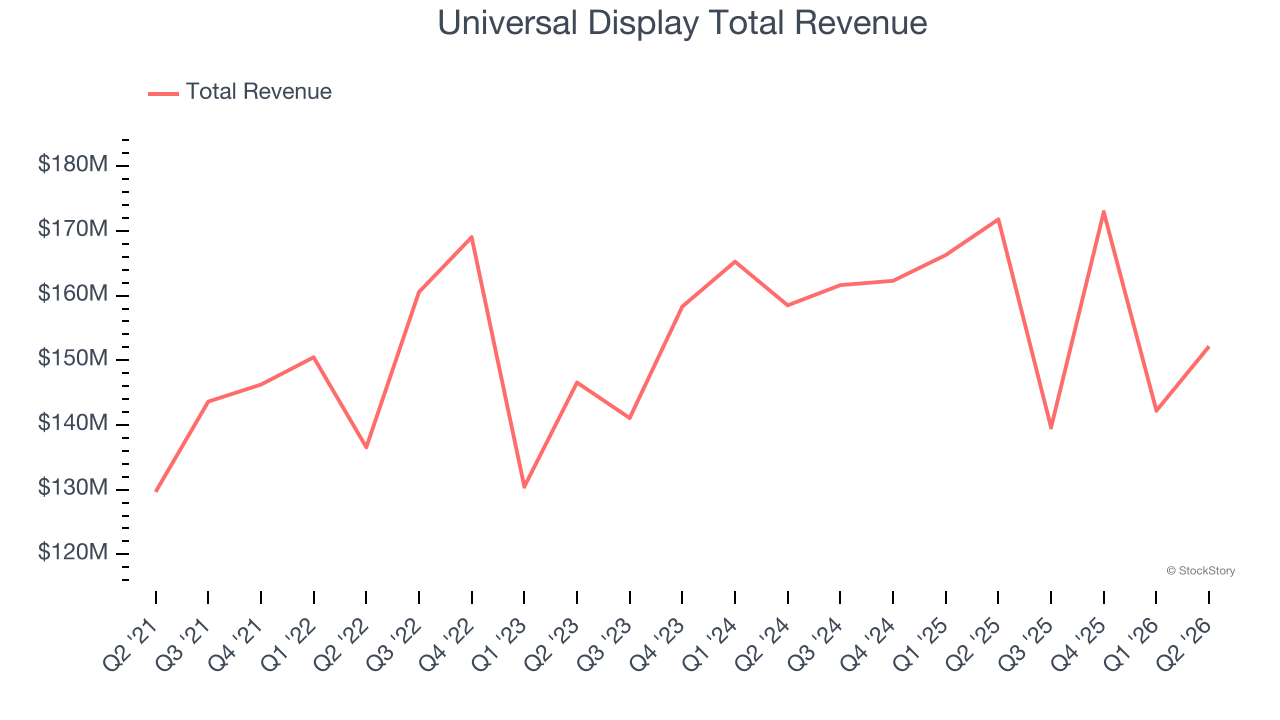
Universal Display delivered the weakest performance against analyst estimates and slowest revenue growth among its peers. The market seems disappointed with the results as the stock is down 2.3% since reporting and currently trades at $78.49.
Read our full report on Universal Display here, it’s free.
Best Q2: Monolithic Power Systems (NASDAQ:MPWR)
Founded in 1997 by its longtime CEO Michael Hsing, Monolithic Power Systems (NASDAQ:MPWR) is an analog and mixed signal chipmaker that specializes in power management chips meant to minimize total energy consumption.
Monolithic Power Systems reported revenues of $980.6 million, up 47.6% year on year, outperforming analysts’ expectations by 8.6%. The business had an incredible quarter with a significant improvement in its inventory levels and a beat of analysts’ EPS estimates.
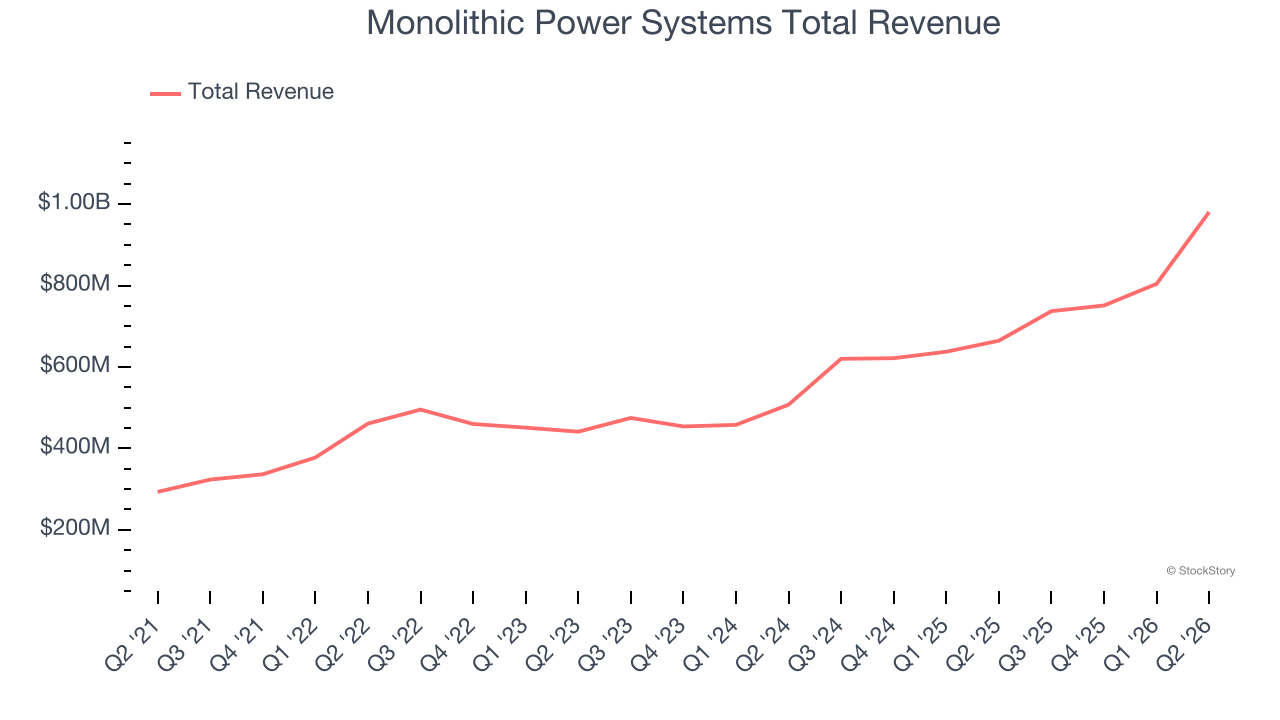
Monolithic Power Systems pulled off the biggest analyst estimate beat, highest guidance raise, and fastest revenue growth in the group. Although it had a fine quarter compared to its peers, the market seems unhappy with the results as the stock is down 13% since reporting. It currently trades at $1,145.
Is now the time to buy Monolithic Power Systems? Access our full analysis of the earnings results here, it’s free.
Himax (NASDAQ:HIMX)
Taiwan-based Himax Technologies (NASDAQ:HIMX) is a leading manufacturer of display driver chips and timing controllers used in TVs, laptops, and mobile phones.
Himax reported revenues of $227.4 million, up 5.9% year on year, exceeding analysts’ expectations by 2%. Still, it was a slower quarter as it posted EPS in line with analysts’ estimates.
As expected, the stock is down 2.2% since the results and currently trades at $13.05.
Read our full analysis of Himax’s results here.
Skyworks Solutions (NASDAQ:SWKS)
Result of a merger of Alpha Industries and the wireless communications division of Conexant, Skyworks Solutions (NASDAQ: SWKS) is a designer and manufacturer of chips used in smartphones, autos, and industrial applications to amplify, filter, and process wireless signals.
Skyworks Solutions reported revenues of $934.8 million, down 3.1% year on year. This print surpassed analysts’ expectations by 0.9%. Taking a step back, it was a satisfactory quarter as it also recorded a beat of analysts’ EPS estimates but an increase in its inventory levels.
The stock is up 38.6% since reporting and currently trades at $89.65.
Read our full, actionable report on Skyworks Solutions here, it’s free.
NXP Semiconductors (NASDAQ:NXPI)
Spun off from Dutch electronics giant Philips in 2006, NXP Semiconductors (NASDAQ: NXPI) is a designer and manufacturer of chips used in autos, industrial manufacturing, mobile devices, and communications infrastructure.
NXP Semiconductors reported revenues of $3.50 billion, up 19.5% year on year. This number beat analysts’ expectations by 0.8%. It was a strong quarter as it also produced a meaningful improvement in its inventory levels and a decent beat of analysts’ operating income estimates.
The stock is down 12.4% since reporting and currently trades at $227.11.
Read our full, actionable report on NXP Semiconductors here, it’s free.
Market Update
Over the past year, investors have been forced to repeatedly answer the same question: what is the market’s biggest risk? The answer has changed several times, and each shift has reshaped market leadership.
Late in 2025 and early 2026, artificial intelligence became the market’s primary uncertainty. Investors questioned whether AI would erode software pricing power and weaken competitive moats as AI made it easier to replicate once-differentiated products.
By the spring, technology took a back seat to geopolitics. The U.S. conflict with Iran briefly became the market’s dominant narrative, raising concerns about oil prices, inflation, and global growth. But as energy markets remained orderly and fears of a prolonged supply disruption faded, investors quickly turned their focus back to fundamentals.
Want to invest in winners with rock-solid fundamentals? Check out our Top 5 Growth Stocks and add them to your watchlist. These companies are poised for growth regardless of the political or macroeconomic climate.